The conference features speakers from India, Taiwan, Thailand, Malaysia, Serbia and the United States, while participants from Iraq, Greece and several other countries are also contributing to the international academic exchange.
Welcoming the dignitaries, speakers and participants, Prof. Raviraja Adikari highlighted the significance of bringing together experts from diverse academic and research backgrounds to discuss advancements in mechanical engineering and nanotechnology.
Presiding over the inaugural ceremony, President, Manipal University Jaipur Prof. N. N. Sharma traced the legacy of the Manipal education group and reflected on the evolution of mechanical engineering over the years. He highlighted the importance of academic pedagogy in preparing students and researchers for changing technological landscapes, emphasising the need to continually adapt teaching and learning practices to meet emerging industry and societal requirements.
In his address as Chief Guest, Prof. Harish Hirani described mechanical engineering as a never-ending field of opportunities, driven by continuous innovation and the development of new technologies. Speaking on the theme of transforming “Ideas to Impact,” he drew on case studies and design-related intellectual property rights to explain how innovative concepts can be translated into practical outcomes. He also highlighted the importance of asking the right questions through the 5Ws and 1H framework—Who, What, When, Where, Why and How—to identify problems, develop solutions and create meaningful impact.
Pro-President Cdr. (Dr.) Anil Rana outlined the various technical tracks of the conference and highlighted the wide-ranging applications of mechanical engineering across major industrial and technological sectors. He underscored the discipline's continuing relevance in addressing complex engineering challenges and supporting innovation across diverse fields.
Addressing the gathering, Prof. Kuldip Singh Sangwan spoke about the need to adopt innovative teaching approaches in an era increasingly shaped by artificial intelligence and machine learning. Describing AI as a boon for mechanical engineering, he emphasised that emerging technologies should be viewed as opportunities to enhance learning, research and professional capabilities rather than as reasons for concern.
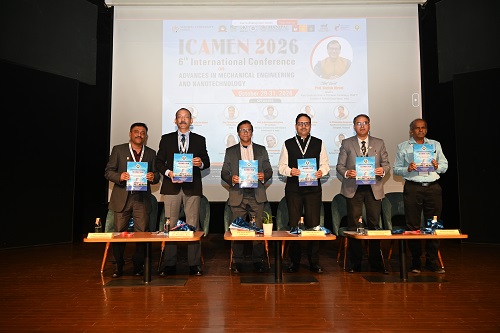
Prof. Santosh Patil presented an overview of ICAMEN 2026, noting that the conference received around 150 abstracts, of which nearly 70 were shortlisted following a rigorous review process. The programme features one plenary session, six keynote addresses and four invited talks, offering participants opportunities to explore contemporary research and technological developments.
Highlighting the conference's research focus and academic significance, Prof. Patil informed that selected papers would be published in a Springer proceedings volume titled Advanced Materials for Sustainable Manufacturing. In addition, two journals published by Begell House have agreed to bring out special issues featuring selected contributions, subject to the peer-review process.
ICAMEN 2026 stands as a testament to the importance of collaboration in advancing engineering research and innovation. Through its international participation, expert deliberations and research-oriented sessions, the conference aims to foster knowledge exchange, encourage interdisciplinary engagement and strengthen partnerships among academic institutions and industry stakeholders.
To know more about Manipal University Jaipur please visit jaipur.manipal.edu.